For years, SEO teams had a stable scoreboard: rankings, impressions, clicks, traffic, conversions. That model still matters, but it no longer captures the entire discovery journey.
When someone asks ChatGPT, Claude, Gemini, or Perplexity for the best tool, agency, or product in a category, the buying journey can begin before a search click ever happens. If your brand is absent from the answer, your pipeline can shrink while your classic SEO dashboard still looks fine.
That is why the next generation of search measurement needs to move from pure SERP performance to AI visibility performance.
Why old KPIs are no longer enough
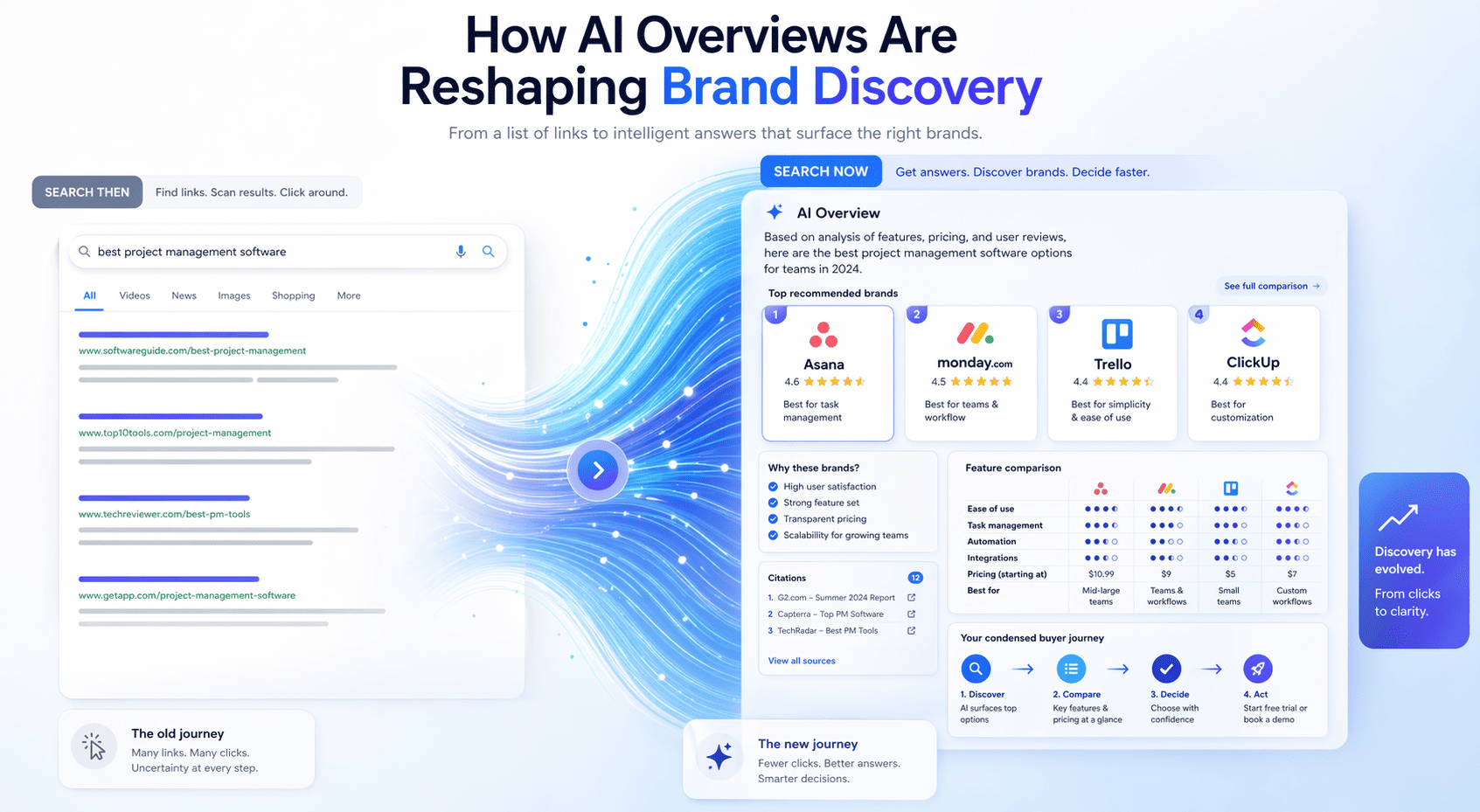
Traditional SEO assumes a user sees links, clicks one, lands on your site, and then decides whether you are relevant. AI assistants compress those stages into a single response.
That creates three measurement problems:
- your brand may influence decisions without earning a visit
- your competitors may be recommended before a prospect ever reaches your site
- your analytics platform may underreport the role AI played in discovery
This is not theoretical. In late 2025, Search Engine Land reported on Seer Interactive data showing a 61% drop in organic CTR on informational queries where Google AI Overviews appeared. The same study also found that brands cited in those AI Overviews earned materially more clicks than brands that ranked but were not cited.
The takeaway is simple: the unit of value is shifting from just position and click share to presence inside the answer itself.
The KPIs that matter now
The best AI-search measurement programs do not rely on one headline metric. They combine visibility, quality, competitive context, and business impact.
1. Mention Share
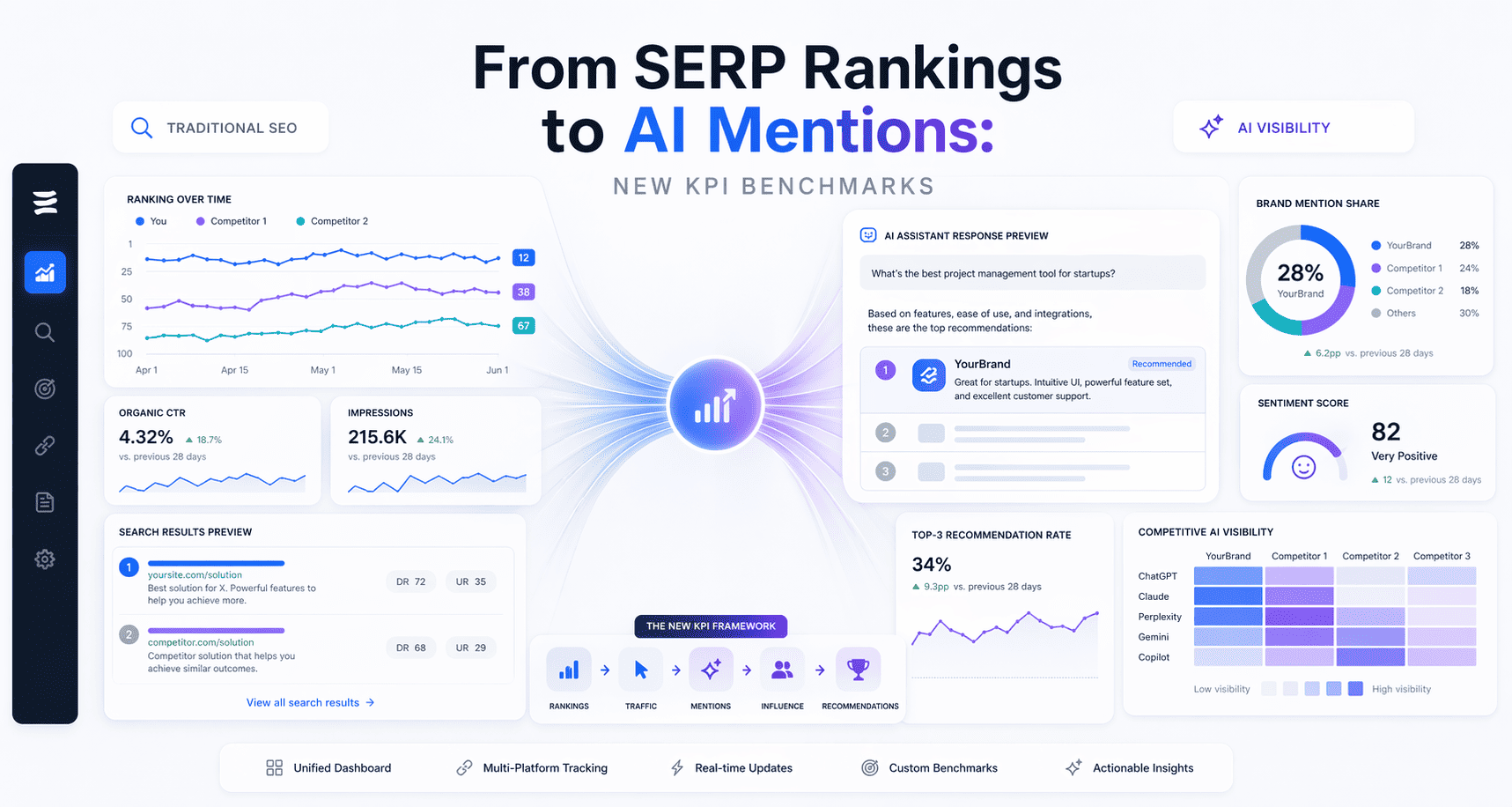
Mention share measures how often your brand appears across a defined set of AI prompts.
This is the most useful top-line KPI because it answers the first strategic question: are you even in the conversation?
Formula:
your brand mentions / total tracked AI responses
If you track 100 relevant prompts across platforms and your brand appears in 18 responses, your mention share is 18%.
Suggested working benchmarks:
| Stage | Mention Share | Interpretation |
|---|---|---|
| Low visibility | < 5% | You are mostly absent from category conversations |
| Early traction | 5-15% | You are appearing, but inconsistently |
| Competitive | 15-30% | You are regularly included in consideration sets |
| Category leader | > 30% | You are one of the default names AI assistants reach for |
These are not universal benchmarks for every industry. A narrow B2B category with five vendors behaves differently from a crowded consumer category. What matters most is your trend line relative to competitors.
2. Recommendation Rate
Mention share answers whether you appear. Recommendation rate answers whether the model is actually endorsing you.
There is a real difference between:
- “PromptMention is one option in the space”
- “PromptMention is a strong choice for teams that want to track AI brand visibility”
Count how often your brand is framed as a recommended solution, not merely listed.
Good rule of thumb:
- below 30% recommendation rate: weak positioning
- 30-60%: credible but inconsistent positioning
- above 60%: strong solution-level recognition
3. Placement Rate
Placement measures where your brand appears in multi-brand responses.
This matters because AI answers are hierarchical. The first recommendation often gets the richest explanation and the highest recall. Brands mentioned fourth or fifth may technically be present while receiving very little user attention.
Track three levels:
- First position rate: how often you are the first brand named
- Top-three rate: how often you appear in the first three recommendations
- Long-list rate: how often you are mentioned only after the key options
For most categories, top-three rate is the most practical KPI because many AI answers only surface a short list.
4. Sentiment and Framing
AI systems do not just list brands. They frame them.
That framing often has more commercial impact than the raw mention itself. A brand described as “enterprise-grade but expensive” will perform differently from one described as “the easiest option for lean teams.”
Track the language around each mention:
- positive framing: recommended, strong fit, leading, best for
- neutral framing: alternative, option, notable vendor
- negative framing: limited, expensive, weaker, niche, missing features
Sentiment alone is not enough. Add a framing taxonomy tied to your category. For example, a B2B SaaS brand might want to track whether it is associated with ease of use, accuracy, integrations, enterprise readiness, or affordability.
5. Query Coverage
Many teams over-focus on one heroic prompt like “best AI monitoring tool.” That is too narrow.
You need coverage across the full shape of buyer intent:
- category prompts: “best media monitoring software”
- use-case prompts: “tools for tracking brand mentions in ChatGPT”
- persona prompts: “best tool for SEO teams”
- comparison prompts: “PromptMention vs Ahrefs for AI visibility”
- problem prompts: “how do I know if AI assistants recommend my brand”
Track how many of your target prompt clusters include your brand. That reveals whether your visibility is broad and durable or dependent on a tiny prompt set.
6. Source Coverage
This is one of the most overlooked KPIs in AI search.
If models keep citing the same publishers, directories, review sites, or product pages when discussing your category, then source coverage becomes a leading indicator of future AI visibility.
Ask:
- which domains are cited most often in category answers?
- how often is your own domain cited?
- which third-party sites mention competitors but not you?
- which source types dominate: editorial, forums, docs, directories, reviews?
This helps you move from reactive measurement to an acquisition strategy for the citations and references that shape AI answers.
7. AI Referral and Assisted Conversion Impact
AI visibility is not only about brand awareness. It should eventually connect to business outcomes.
That means tracking:
- AI referral sessions where identifiable
- assisted branded search lift after AI visibility improvements
- sales-call self-reported discovery sources
- demo requests from AI-referred users
- changes in win rate for accounts already familiar with your brand
You will not get perfect attribution. That is normal. The goal is directional evidence, not fantasy-level precision.
A practical benchmark model for teams
If you are building your first AI visibility dashboard, start with a lean scorecard rather than a huge reporting system.
Track these five numbers first:
| KPI | Why It Matters |
|---|---|
| Mention share | Baseline presence in relevant answers |
| Top-three placement rate | Whether you are in the actual consideration set |
| Recommendation rate | Whether the model endorses you or just names you |
| Positive framing rate | Whether the brand narrative is helping or hurting |
| Query coverage by cluster | Whether visibility is broad across use cases |
Then layer on:
- source coverage
- competitor mention overlap
- AI referral trends
- branded search lift
How to build the measurement program
Step 1: Define your prompt universe
Do not measure random prompts. Build a fixed set of prompts that represent real buying behavior.
Most teams should start with 25 to 75 prompts split across:
- category
- use case
- feature
- comparison
- persona
- pain point
This matters because a single prompt can produce noisy results. A prompt set produces an actual pattern.
Step 2: Track across multiple assistants
Do not assume ChatGPT represents the entire market.
At minimum, track:
- ChatGPT
- Claude
- Gemini
- Perplexity
Each platform has different retrieval behavior, memory of brands, and citation habits. A brand that is strong in Perplexity may still be weak in Claude.
Step 3: Normalize the evaluation rubric
Before you compare month over month, define what counts as:
- a mention
- a recommendation
- a positive frame
- a top-three placement
Without a fixed rubric, your benchmark data will drift and become hard to trust.
Step 4: Compare yourself to named competitors
Absolute numbers are useful, but the real story is competitive movement.
If your mention share improves from 8% to 14%, that is good. If a competitor improved from 20% to 38% during the same period, the market picture is different.
The best scorecards include:
- your visibility
- competitor visibility
- overlap prompts where both brands appear
- prompts where competitors appear and you do not
Step 5: Tie insights to actions
Measurement is only useful if it produces work.
Examples:
- low comparison-query coverage -> publish better comparison pages
- weak framing around price -> improve pricing explanation and review-site coverage
- poor first-position rate -> strengthen source authority and answer clarity
- missing mentions in a persona cluster -> create content tailored to that buyer segment
Common mistakes teams make
Treating mention counts as enough
A mention without placement, sentiment, and recommendation context is incomplete. You need all three to understand commercial value.
Measuring too few prompts
Five prompts are fine for a quick manual audit. They are not enough for a benchmark.
Ignoring source-level patterns
If competitors are repeatedly backed by reviews, forums, or editorial coverage you do not have, the gap is not only content quality. It is source representation.
Demanding perfect attribution
AI discovery will often show up indirectly through branded search, direct traffic, or sales conversations. Do not wait for perfect analytics before taking the channel seriously.
What good looks like in 2026
Strong teams are moving toward a measurement model that looks like this:
- a fixed prompt set
- weekly or daily automated tracking
- platform-by-platform comparison
- visibility and framing metrics in one dashboard
- competitor benchmarking
- clear links from measurement to content, PR, and product-page updates
That is the shift: SEO is no longer only about ranking documents. It is also about becoming one of the brands AI systems surface, summarize, and trust.
The bottom line
SERP rankings still matter. But if you only measure what happens before the click, you will miss what is happening inside the answer.
The new KPI stack is not complicated, but it is different. Start with mention share, placement, recommendation rate, sentiment, and query coverage. From there, build a system that connects AI visibility to the business outcomes your team already cares about.
That is how AI search stops being a vague trend and becomes an operating channel.